
 By adnanshabbir942@gmail.com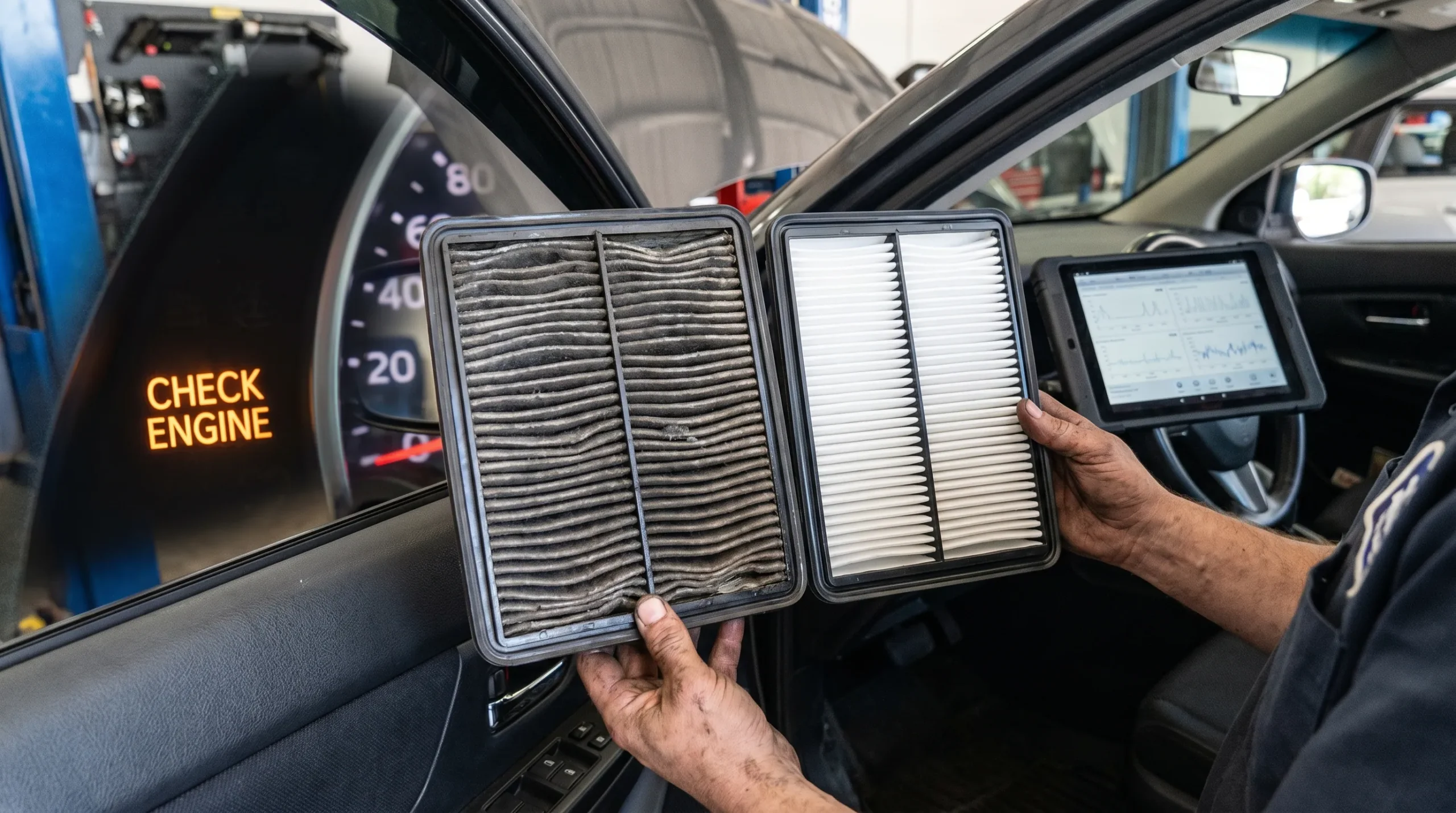
Can a dirty air filter cause a check engine light? Yes, it can — but in most cases, it happens indirectly, not because the engine air filter itself has an electrical fault, but because restricted airflow can upset the way your engine measures and manages air, fuel, and emissions.
That distinction matters. When drivers see the check engine light, also called the CEL or malfunction indicator lamp (MIL), they often assume something expensive has failed. Sometimes that is true. But sometimes the real issue starts with something much simpler: a dirty air filter, a loose air filter housing, a contaminated Mass Air Flow sensor (MAF sensor), or even unmetered air entering through an intake hose or intake duct.
A modern engine depends on a precise air-fuel mixture. If the filter is severely clogged, airflow can become restricted enough to affect engine airflow performance, alter fuel trim, and in some cases contribute to trouble codes like P0101, P0171, P0174, P0102, P0103, or even a random misfire code like P0300. That does not mean every clogged filter will trigger a warning light, and it does not mean every check engine light after an air filter replacement was caused by the filter itself. But it does mean the filter deserves a serious look during diagnosis.
In this guide, you will learn how dirty air filters can trigger your check engine light, what symptoms to watch for, what error codes may appear, how to tell a dirty filter from a vacuum leak or dirty MAF sensor, and what to do if the light stays on after you change the filter.
The Short Answer: Yes, but Usually Indirectly
A dirty air filter check engine light situation usually happens because the engine is struggling to get the proper amount of air it needs. The filter’s job is simple but important: stop harmful particles and debris before they enter the intake system and combustion chamber. When the filter becomes heavily contaminated, the engine may not get an adequate supply of air, and that can throw off the balance between incoming air and injected fuel.
In older carbureted engines, this kind of restriction could affect how the engine ran in a more mechanical way. In modern fuel-injected engines, the issue is usually detected by electronics. The ECM or engine control module watches sensors like the MAF sensor and oxygen sensor (O2 sensor) to keep the optimal mix of air and fuel. If airflow becomes too restricted, sensor readings may no longer match expected engine load and RPM. That can lead to inaccurate sensor readings, an abnormal rich condition or lean condition, incomplete combustion, increased vehicle emissions, and eventually a stored code.
So, can a dirty air filter trigger a check engine light? Yes — especially when it is extremely clogged, installed poorly, or part of a larger intake problem. But in many cars, the filter is more likely to contribute to performance issues first, such as sluggish acceleration, reduced fuel economy, and rough idle, before the warning light turns on.
What the Engine Air Filter Actually Does
The engine air filter sits in the air box or air filter housing and acts as the first line of defense for the engine. Every time your vehicle pulls in outside air, that air can carry dust, pollen, dirt, and other contaminants. The filter traps those particles so the engine gets cleaner air for combustion.
That matters because internal combustion depends on efficient combustion. Your engine needs fuel, spark, and a steady flow of clean air. If the filter is working properly, the engine can breathe easily and maintain unrestricted airflow through the intake system. That supports combustion efficiency, protects the spark plugs, reduces contamination inside the engine, and helps maintain engine health and vehicle performance.
When the filter becomes clogged, air has to struggle to pass through the media. This air struggle to pass through the filter can force the engine to work harder, especially under load. Over time, that can cause a subtle decrease in performance, worse fuel efficiency, and more stress on the systems that monitor emissions and airflow.
It is also important not to confuse the engine air filter with the cabin air filter. The cabin air filter affects the air inside the car’s interior and HVAC system. The engine air filter affects the air going into the engine. If you are asking whether a filter can cause the check engine light, the relevant part is almost always the engine air filter, not the cabin air filter.
How a Dirty Air Filter Can Trigger the Check Engine Light
To understand why a clogged air filter turns on the check engine light, it helps to follow the chain of events.
First, the filter becomes loaded with dust and debris. That creates airflow restriction. The engine now has a harder time drawing in air, especially during acceleration or high load. The MAF sensor measures incoming air, while the oxygen sensors monitor oxygen content in the exhaust. The ECM compares all of this data to decide how much fuel to inject.
When airflow becomes restricted, the engine may receive less air than expected. Depending on the design of the vehicle, this can create a skewed fuel mixture. In some cases, the engine may run too rich, meaning there is too much fuel compared with air. In other cases, especially when the intake system has sealing problems after a filter change, the engine may read lean because unmetered air is getting in elsewhere. Either way, the sensors start sending data that does not fit the ECM’s expected pattern.
This is where airflow-related error codes begin to appear. A very common one is P0101, which points to a mass airflow sensor range or performance issue. You may also see P0102 or P0103 if the MAF signal is too low or too high. If the imbalance becomes severe enough to affect combustion, you may see a P0300 random misfire code. If the engine is compensating for a lean condition, you may see P0171 on Bank 1 or P0174 on Bank 2.
In more technical terms, the ECM is trying to correct the mixture through short-term fuel trim and long-term fuel trim. If those corrections go too far, the computer sets a code. That is why a dirty filter does not always trigger the light immediately. The computer may compensate for a while. But if the problem crosses a threshold, the dashboard warning light comes on.
A severely dirty filter can also contribute to poor combustion, engine misfire, dirty spark plugs, fouled spark plugs, carbon deposits, and increased stress on the catalytic converter. That is why something as simple as a filter can turn into a larger repair if ignored for too long.
Symptoms That Often Show Up With a Dirty Air Filter
A dirty air filter symptoms article often lists the warning light first, but in real life, most drivers notice other things before they notice the CEL.
The most common symptom is reduced fuel economy. When the engine is not breathing properly, it may work harder and burn more fuel. Some sources even claim a fresh filter can improve gas mileage by up to 10% or up to 11%, though results vary by vehicle and driving style. The point is not the exact number. The point is that a clogged filter can absolutely hurt efficiency.
Another common sign is loss of power or sluggish acceleration. The engine simply cannot pull in air as easily, so response feels weaker. Some drivers describe this as lackluster acceleration, lower horsepower, or a car that feels flat when merging or climbing hills.
You may also notice rough idle, rough idling, or occasional stalling. If combustion becomes unstable, the engine may shake at stoplights or feel uneven at idle. In more advanced cases, the car can become harder to start, especially if airflow is severely restricted or the plugs have become fouled.
Other clues include dark exhaust smoke, a strong fuel smell, and unusual engine noises such as popping noises. Jessup-style symptom lists also mention violent vibrations and repeated noises when the engine is misfiring. Those are signs you should not ignore.
A simple way to remember the pattern is this:
| Symptom | What it may mean |
|---|---|
| Reduced gas mileage | The engine is burning more fuel than normal |
| Loss of power | Airflow is restricted and combustion is less efficient |
| Rough idle | The air-fuel ratio may be unstable |
| Difficulty starting | Airflow or ignition quality may be compromised |
| Engine noises | Misfires or poor combustion may be developing |
If your car is showing 1. Reduced Gas Mileage, 2. Loss of Power, 3. Rough Idle, 4. Difficulty Starting, or 5. Engine Noises, the air filter is worth inspecting right away.
Fuel Economy, Performance, and Emissions: What Changes First?
The first thing many drivers notice is not the warning light but a gradual decline in how the car feels. A dirty filter can create a subtle decrease in performance that is easy to overlook at first. Maybe the car feels a little slower. Maybe throttle response seems dull. Maybe fuel stops happen more often.
That is because the engine depends on engine airflow performance to make power cleanly. When airflow is limited, combustion quality drops. The engine may no longer maintain the fuel and air ratio it wants under all conditions. The result can be reduced acceleration, less engine performance, and poorer emissions.
This matters for emissions because modern cars are calibrated tightly. The oxygen sensors and ECM do not just care whether the car runs; they care whether it runs cleanly. A clogged filter can contribute to increase vehicle emissions, especially if it helps create a persistent rich or unstable mixture. That is one reason the check engine light exists in the first place.
What Trouble Codes Might Appear?
If you scan the car through the OBD-II port with a diagnostic scan tool, you may find several possible codes.
The most obvious airflow-related code is P0101, which usually points to a MAF sensor range or performance problem. This does not automatically prove the MAF sensor itself is bad. It can also happen when airflow is abnormal because the filter is clogged, the intake path is restricted, or the sensor is dirty.
You may also see P0102 or P0103, which suggest the MAF signal is lower or higher than expected. If the engine is running too lean, P0171 and P0174 are especially important. These lean codes often point to vacuum leak, intake leak, or fuel delivery issues, but they can also appear in an airflow-related diagnosis. A misfire code such as P0300 can show up if poor combustion gets worse.
There is a big difference between pending codes and stored codes. A pending code means the fault has been seen but has not yet matured enough to turn on the light every time. A stored code means the ECM has confirmed the issue. This is why a driver may feel symptoms before the light becomes persistent.
A useful quote to remember is this: “The code tells you where to look, not what part to replace.” That mindset prevents unnecessary parts swapping.
Read the Scanner Data, Not Just the Light
One of the biggest mistakes drivers make is treating the check engine light as the diagnosis. It is not. It is just the signal that the computer saw a problem.
The real clues are in the scanner. Look at freeze frame data, live data, and whether the code is pending or confirmed. Freeze frame data captures operating conditions at the moment the fault set — engine speed, load, temperature, and fuel corrections. That snapshot can help you see whether the issue appeared at idle, under acceleration, or only after the engine warmed up.
Live data is also valuable. If the MAF reading looks inconsistent for the engine load, or if fuel trims swing heavily positive, that suggests the ECM is compensating for an airflow or mixture problem. That is far more useful than clearing the light and hoping it stays off.
Fuel Trim Explained in Plain English
Many competing articles mention the air-fuel mixture but stop there. A better article explains fuel trim because that is how the ECM responds in real time.
Think of short-term fuel trim as the computer’s immediate correction and long-term fuel trim as its memory of the problem over time. If the engine is seeing less air than expected or extra unmetered air, the ECM will try to adjust fuel delivery to keep combustion stable.
If the trims stay too positive, the engine may be compensating for a lean condition, which can help explain P0171 or P0174. If the trims move strongly negative, the engine may be pulling fuel back from a rich condition. Either way, these numbers tell you much more than the warning light alone.
This is where Bank 1 and Bank 2 matter on V-style engines. A single-bank problem may point to something localized. A both-bank issue may suggest a system-wide airflow or fuel problem.
Dirty Filter vs. Dirty MAF Sensor vs. Intake Leak
This is where diagnosis gets practical.
A dirty air filter usually causes gradual symptoms: reduced economy, mild power loss, and eventually airflow-related codes. A dirty MAF sensor can create similar symptoms, but it may do so even with a clean filter because the sensor is misreporting airflow. An intake leak, cracked intake tube, or disconnected hose often causes lean codes because extra air enters after the MAF sensor, which means the computer never measured it.
A poorly sealed air filter housing, loose air box, or bad fit after DIY air filter replacement can create the same kind of confusion. This is one reason the check engine light stays on after air filter replacement in some cases. The old filter may be gone, but a new intake leak has been introduced.
Aftermarket parts can complicate things too. An aftermarket intake or over-oiled filter may contaminate the MAF sensor. In that case, the real solution may involve cleaning the sensor with proper MAF cleaner, resealing the housing, and checking the intake boot, intake hose, and intake duct for leaks.
Is It Safe to Drive? What to Do First
If the car only has a steady check engine light and mild symptoms, you can often begin with a basic inspection. Check the engine air filter, make sure the air filter housing is sealed correctly, inspect the intake hose for cracks, and scan for codes.
But if the engine is misfiring badly, has severe loss of power, smells strongly of fuel, or the light is flashing, stop guessing. A flashing MIL can point to active misfire that may damage the catalytic converter.
So, safe to drive with check engine light? Sometimes briefly, yes. But only if symptoms are mild and the car is otherwise stable. If the engine is shaking, stalling, or clearly running poorly, diagnose it immediately.
How to Inspect or Replace the Engine Air Filter Correctly
Replacing an air filter is usually simple, but it should still be done carefully.
Open the air filter housing, remove the old filter, and inspect the box for dirt or debris. Insert the new filter in the correct orientation and make sure the housing closes evenly. This is where proper fit matters. A badly seated filter can allow dirt in or create gaps that upset airflow.
Do not assume every air filter replacement solves the problem instantly. If the filter was only part of the issue, the light may remain on until the computer completes enough driving cycles to confirm the fault is gone, or until codes are cleared. If the code came back after replacing the air filter, look for a dirty MAF sensor, loose air filter housing, vacuum leak, or another intake issue.
When Should You Replace the Air Filter?
Most vehicles do not need a new filter every oil change, but they do need regular inspection. Common guidance falls around 12,000 miles, 12,000–15,000 miles, or roughly 19,300 km, and sometimes once a year or annually under normal driving.
But local climate driving conditions matter. If you drive in dusty conditions, polluted environments, heavy road construction, rural roads, or severe weather, your filter may clog much faster. That is why the owner’s manual and vehicle manufacturer recommendations should always come first.
A severe maintenance schedule is not just dealer upselling. It reflects real contamination risk.
Engine Air Filter vs. Cabin Air Filter
This confusion deserves a quick answer. The engine air filter protects the engine and influences combustion, airflow, and emissions. The cabin air filter cleans air for the passenger compartment.
So if someone asks about the difference between cabin air filter and engine air filter in relation to the check engine light, the answer is simple: the engine air filter is the one that matters.
A Quick Real-World Case Study
Imagine a driver notices weaker acceleration and worse mileage over several weeks. Then the CEL comes on. A scan shows P0101 and a pending P0171. The filter is found heavily clogged, and the MAF sensor has light contamination. The filter is replaced, the MAF is cleaned, and the housing is resealed. Fuel trims normalize, the code does not return, and performance improves.
That is a realistic example of how a basic maintenance item can contribute to a warning light without being the only part involved.
Frequently Asked Questions
Will the check engine light reset itself after replacing the air filter?
Sometimes. If the fault is gone, the ECM may turn the light off after enough successful driving cycles. In other cases, you may need to clear the stored codes with a scan tool.
Can a dirty air filter cause P0171 or P0174?
It can contribute, but those lean codes more often point to vacuum leak, intake leak, or fuel delivery issues. That is why freeze frame data and fuel trim matter.
Can a dirty air filter damage my engine?
If ignored for long enough, it can contribute to poor combustion, dirty spark plugs, carbon deposits, and extra stress on the catalytic converter.
Why is the light still on after I changed the filter?
Because the filter may not have been the only problem. Check for a dirty MAF sensor, loose air box, cracked intake tube, or pending codes that matured into a stored fault.
Can an incorrectly installed air filter cause a CEL?
Yes. A poor seal, loose housing, or disturbed intake connection can create airflow problems or unmetered air.
Final Words
So, can a dirty air filter cause a check engine light? Yes — but usually because it affects the engine’s airflow, sensor readings, and combustion quality rather than because the filter itself “fails” electronically.
The smartest way to approach a dirty air filter check engine light problem is to think bigger than the filter alone. Inspect the filter, yes. But also check the MAF sensor, scan the car, review fuel trim, look for vacuum leaks, and confirm the air filter housing is sealed correctly. That is how you separate a simple maintenance issue from a deeper intake or emissions problem.
Disclaimer:
This article is for general informational purposes only and does not replace professional automotive inspection or repair services. A dirty engine air filter can indirectly trigger a check engine light by affecting airflow, sensor readings, and fuel mixture, but exact causes, error codes, and solutions may vary by vehicle make, model, and condition. Always consult a qualified mechanic or technician for diagnosis and repair.