
 By adnanshabbir942@gmail.com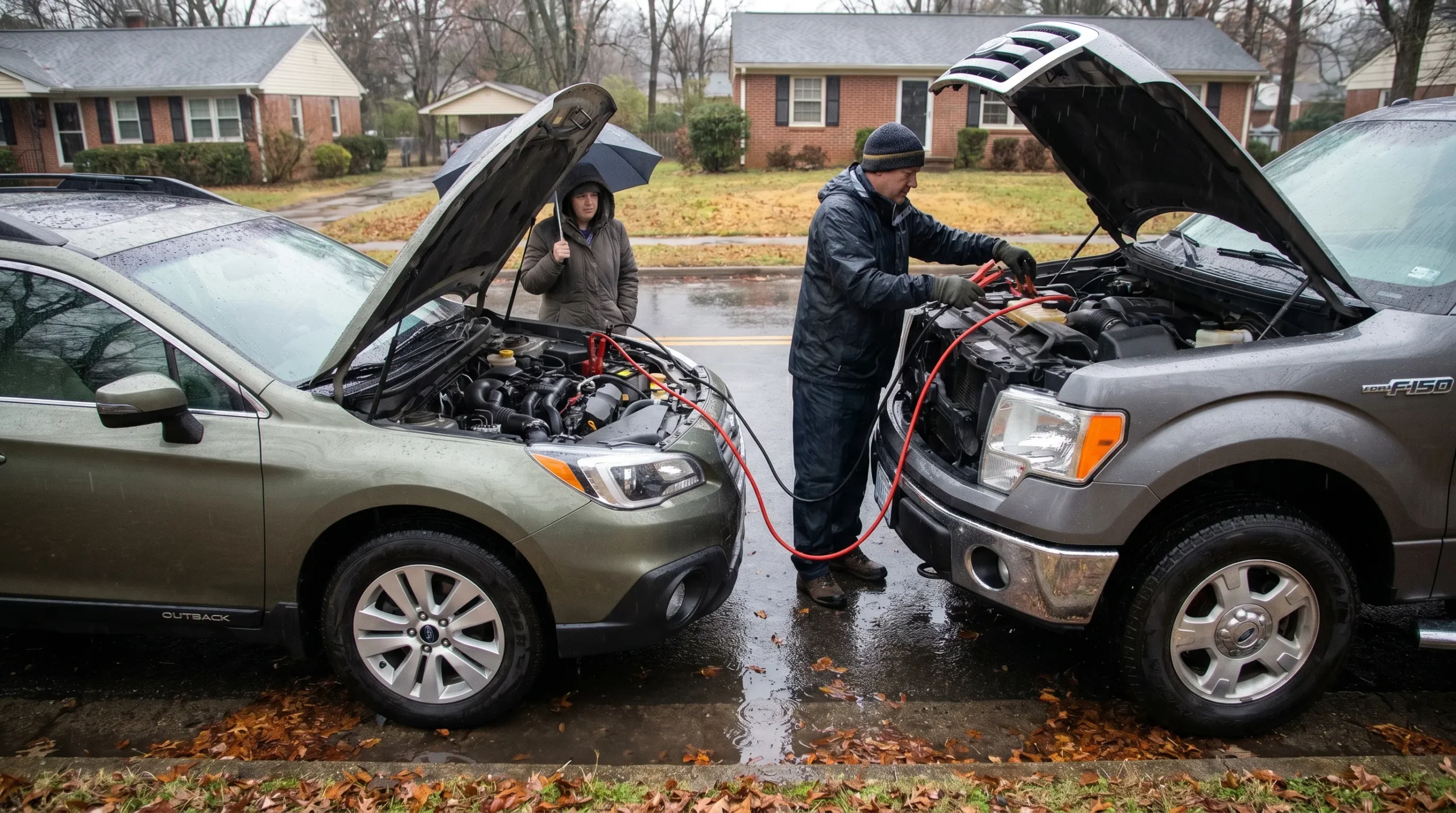
Can you jump cars in the rain safely? In many normal situations, yes, you can jump-start a car in the rain, but only if the weather is not severe, the ground is safe, the jumper cables are in good condition, and you follow the correct steps. Light rain by itself does not usually make a car battery impossible to jump, but wet weather does add risks.
The biggest dangers are not always the rain itself. The real problems are standing water, damaged cables, exposed wires, wrong cable connections, battery leaks, and unsafe roadside conditions. If there is lightning, flooding, a cracked battery, or you are stuck on a busy road with poor visibility, it is better to call roadside assistance or a tow service instead of trying to do it yourself.
This guide explains how to jump a car in the rain safely, when not to try it, what mistakes to avoid, and what to do if the car still will not start.
Can You Jump a Car in the Rain?
Yes, you can usually jump a car in the rain if the conditions are safe. A standard vehicle battery is part of a low-voltage system, and a light rain does not automatically make the process dangerous. However, that does not mean you should ignore safety. Water can make clamps slippery, reduce visibility, and increase the chance of a poor connection.
When people ask, “is it safe to jump a car in the rain?”, the best answer is: it can be safe if you avoid standing water, use good cables, keep your hands and tools controlled, and connect everything in the correct order.
A dead battery in wet weather is common, especially during cold or rainy seasons. Heaters, window defrosters, lights, and wipers all add extra demand to your vehicle’s electrical system. If your battery is already weak, rainy or cold weather may be the moment it finally fails.
The key is to slow down and check the situation before touching anything. If the battery looks normal, the cables are insulated, the cars are parked safely, and there is no floodwater or lightning, jump-starting is usually possible. If something feels unsafe, do not force it.
When Is It Safe — and Not Safe — to Jump-Start in Rain?
Before connecting red and black jumper cables, decide whether the situation is safe. This is especially important if you are outside in heavy rain, on a roadside, or in a dark parking lot.
| Situation | Safe to Try? | Best Action |
| Light rain with dry or mostly dry ground | Usually yes | Follow the correct jump-start steps |
| Heavy rain with poor visibility | Risky | Wait, move to shelter, or call help |
| Lightning nearby | No | Stay inside the vehicle or a safe building |
| Standing water around the vehicle | No | Do not jump-start in water |
| Battery is leaking, cracked, or swollen | No | Call a mechanic |
| Jumper cables have exposed wires | No | Do not use them |
| You are unsure about a hybrid or EV battery | Maybe | Check the owner’s manual first |
You should not jump-start a car in the rain if you are standing in a puddle, the vehicles are in floodwater, or there is lightning nearby. Water around your feet can make the work more dangerous, and lightning creates a separate serious risk.
Also avoid jump-starting if the battery has a strong sulfur smell, visible leaks, heavy corrosion, cracks, or bulging sides. A damaged battery can release battery acid or hydrogen gas, and sparks near a battery can be dangerous.
Why Jump-Starting in Wet Weather Can Be Risky
Jump-starting a car in wet conditions is not automatically unsafe, but wet weather makes common mistakes more likely. Rain can make the battery terminals slippery, make your hands less steady, and cause cable clamps to move if they are not attached firmly.
The main risks include electric shock, short circuit, sparks, battery damage, and damage to sensitive electronics. In many cases, these problems come from improper cable connection, not from rain alone.
For example, if the red clamp touches the wrong terminal or the black clamp touches the red clamp, it can cause sparks. If the final black clamp is placed too close to the dead battery, sparks may occur near flammable hydrogen gas. That is why many jump-start instructions recommend connecting the final black clamp to an unpainted metal surface, such as part of the engine block or car frame, instead of directly to the dead battery’s negative terminal.
Wet weather also creates basic physical risks. You may slip, trip over stretched cables, or work too close to traffic. The safest jump-start is not just about the battery. It is also about your position, visibility, footing, and surroundings.
Can Jumper Cables Shock You in the Rain?
A common fear is, “can jumper cables shock you in the rain?” In normal conditions, a standard car battery is usually a 12V low-voltage battery, so it is not like touching household electrical wiring. However, that does not mean there is no risk.
You can increase the danger if you use damaged jumper cables, touch exposed metal clamp ends, stand in water, or connect the cables incorrectly. Wet hands can also make it easier to slip and accidentally touch the wrong part.
To reduce risk, wear rubber gloves or insulated gloves if available. Stand on dry ground, not wet grass or puddles. Avoid touching metal parts of the clamps once they are connected. Never let the red and black clamps touch each other.
If your cables have cracked insulation, exposed wires, loose clamps, or corrosion, do not use them. A safe jump-start depends heavily on using jumper cables with proper insulation, strong clamps, and secure connections.
What You Need Before Jump-Starting a Car in the Rain
Before you begin, gather the right tools and check their condition. You do not need a full mechanic’s kit, but a few simple items can make the process safer.
Helpful items include jumper cables, a portable jump starter, gloves, a towel or cloth, a flashlight, and protective eyewear. If you keep an emergency car kit for rain, it may also include a reflective triangle, high-visibility vest, battery terminal brush, phone charger, and small umbrella.
Your jumper cables should have thick insulation and clean clamps. Do not use cables with broken coating, exposed wires, or weak clamp pressure. The clamps need to grip the terminals securely so they do not slip off during the jump.
A towel or cloth is useful for drying the battery terminals before connecting the clamps. If the terminals are covered with battery corrosion, you may need a wire brush or terminal cleaner. Some people use a mild baking soda solution to clean corrosion, but only do this when you are not rushing and can work safely.
If you are on the side of the road, your first tool is not a cable. It is visibility. Turn on hazard lights and stay away from traffic.
How to Jump a Car in the Rain Safely
Here is a simple 5-step jump-start process for wet weather. Always check your owner’s manual first, especially for newer vehicles, hybrids, and EVs.
Step 1: Position the Cars on Safe Ground
Park the working vehicle close enough to the dead vehicle so the cables reach without stretching. The vehicles should not touch. Put both cars in park or neutral, set the parking brakes, and turn off both engines.
Choose a stable surface away from puddles, mud, wet grass, or standing water. If the vehicles are on a busy roadside, make sure you are visible and not standing in traffic. If you cannot work safely, call roadside assistance.
Step 2: Dry the Battery Terminals
Open the hoods and locate the batteries. Some vehicles have remote jump points instead of an easily accessible battery, so check the manual if you are unsure.
Use a towel or cloth to dry off the battery terminals. You do not need everything to be perfectly dry, but the connection points should not be covered in water. Look for corrosion, loose cables, cracks, leaks, or swelling.
If the battery is leaking or damaged, stop. Do not jump-start a leaking battery.
Step 3: Connect the Jumper Cables in the Correct Order
The correct jumper cable order in the rain is very important. Work slowly and do not let the clamps touch each other.
Follow this order:
- Connect the red clamp to the positive red “+” terminal on the dead battery.
- Connect the other red clamp to the positive terminal on the good battery.
- Connect the black clamp to the negative black “-” terminal on the good battery.
- Connect the final black clamp to an unpainted metal surface on the dead vehicle, such as the engine block or car frame.
This final ground connection helps reduce the chance of sparks near the dead battery.
Step 4: Start the Working Vehicle, Then the Dead Vehicle
Start the vehicle with the good battery first. Let it run for a minute or two. In some cases, waiting a few minutes gives the dead battery enough charge to respond.
Then try starting the dead vehicle. Do not crank the engine for too long. If it does not start after a few short attempts, stop and check the cable connections. If it still fails, the problem may be a bad battery, alternator, starter, or another electrical issue.
Step 5: Remove the Jumper Cables in Reverse Order
Once the dead car starts, remove the cables in reverse order:
- Black clamp from the grounded metal surface
- Black clamp from the good battery
- Red clamp from the good battery
- Red clamp from the revived battery
Keep the clamps from touching each other while removing them. After the vehicle starts, let the engine run for at least 10 minutes before shutting it off.
Common Mistakes to Avoid When Jumping a Car in the Rain
Many jump-start problems come from rushing. Rain can make people hurry, but that is when mistakes happen.
One major mistake is connecting the cables in the wrong order. Reversing the positive and negative clamps can cause sparks, damage electronics, or create a short circuit. Always identify the positive terminal and negative terminal before attaching anything.
Another mistake is standing in water. Never jump-start a vehicle while your feet are in a puddle or floodwater. Move to a safer location if possible.
Do not use damaged jumper cables. Exposed wires, cracked insulation, or loose clamps can create unsafe connections. Also avoid letting the clamps touch each other after one end is connected to a battery.
Do not ignore battery corrosion. Heavy corrosion can prevent a secure connection and may irritate skin. Gloves help protect you from both corrosion and battery acid.
Finally, do not keep trying again and again if the car will not start. Repeated failed attempts can point to a deeper issue, such as a dead battery that needs replacement, a bad alternator, or a starter problem.
Can You Use a Portable Jump Starter in the Rain?
Yes, you may be able to use a portable jump starter in the rain, but only if the device is designed for safe use in wet conditions and you follow the instructions. A battery booster pack can be helpful because you do not need another vehicle, which is useful if you are alone in a parking lot or driveway.
However, a portable jump starter is still an electrical device. Do not leave it sitting in heavy rain unless it is rated for water resistance. Look for terms such as weather-resistant jump starter, water-resistant battery booster, or an IP rating. For example, an IP65 jump starter may offer protection against dust and water spray, but you should still follow the manufacturer’s instructions.
Modern portable jump starters may include safety features such as reverse polarity protection, overcurrent protection, and spark-proof technology. These features can help, but they do not replace careful handling.
Keep the booster pack as dry as possible, connect the clamps correctly, and avoid standing in puddles. If the weather is severe, wait or call help.
Jumper Cables vs Portable Jump Starter in Wet Weather
Both jumper cables and a portable jump starter can work in wet weather, but they are useful in different situations.
| Option | Best For | Main Risk in Rain |
| Jumper cables | When another working car is available | Wrong cable order, clamp contact, wet ground |
| Portable jump starter | Solo emergencies | Device exposure to water or low charge |
| Smart jumper cables | Extra protection | Still need correct setup |
Jumper cables are simple and reliable, but they require another vehicle. You also need enough space to position the cars safely. In rain, that can be difficult if you are in a tight parking spot or on a roadside.
A portable jump starter is easier when you are alone. It also avoids needing another driver to park close to you. The downside is that it must be charged and protected from heavy water exposure.
For many drivers, the best choice is to keep both: a good set of insulated jumper cables and a charged portable jump starter in the emergency kit.
Can Jump-Starting in Rain Damage Modern Car Electronics?
Rain alone is not usually what damages modern vehicle electronics. The bigger risk is incorrect jump-starting. Newer cars can have sensitive electronic components, sensors, modules, and computer systems that may be affected by voltage spikes or reverse polarity.
This is why the owner’s manual matters. Some vehicles have special jump-start terminals under the hood, even if the battery is located elsewhere. Others may warn against using certain connection points.
To reduce the risk of ECU damage from jump-starting, use the correct cable order, avoid loose clamps, never reverse positive and negative connections, and do not guess if the battery layout is unfamiliar.
If the vehicle shows warning lights after a jump-start, or if the engine runs roughly, have the charging system checked. A qualified mechanic can test the battery, alternator, and electrical system to make sure nothing was damaged.
Can You Jump-Start a Hybrid or Electric Car in the Rain?
Many hybrids and electric vehicles have a 12V battery that powers low-voltage systems, even though they also have a larger high-voltage battery. In some cases, a hybrid or EV can be jump-started through its 12V system, but you must follow the vehicle manual exactly.
Do not touch or inspect high-voltage components. These parts are not the same as a normal car battery and can be dangerous. If you are unsure which battery is which, do not guess.
For EV 12V battery jump start safety, check the manual for the correct jump points and warnings. Some EVs can receive a jump to power the low-voltage system, but they may not be designed to jump-start another vehicle.
In rain, the same basic safety rules apply: avoid standing water, damaged cables, lightning, and exposed electrical components. If you are uncertain, call roadside assistance or the vehicle manufacturer’s support service.
What to Do If the Car Still Won’t Start After a Jump
If the car still will not start after a jump, do not panic. Start with the simple possibilities first.
The cable clamps may not be making a secure connection. Turn everything off and check that the clamps are attached firmly to clean metal. Corroded terminals can block current, so the battery may not receive enough power.
If the lights turn on but the engine does not crank, the problem may be the starter. If the car starts but dies shortly after, the alternator may not be charging the battery. If the car only clicks, the battery may be too weak or completely failed.
A battery that is three to five years old is more likely to fail, especially in cold or wet weather. Battery testing can confirm whether it still holds a charge.
A simple case study: a driver leaves work during a rainy evening and finds the car clicking but not starting. A coworker helps with jumper cables, but the car still will not start. After checking the terminals, they find heavy corrosion. Once cleaned and reconnected, the car starts. The next day, a battery test shows the battery is weak and needs replacement. This shows why the jump-start is sometimes only the first clue.
What to Do After the Car Starts
After the car starts, do not shut it off immediately. Let it run for at least 10 minutes, and if possible, drive for a while to help the battery recharge. The exact time can vary, so your owner’s manual is the best guide.
Watch the dashboard. If the battery light stays on, the charging system may have a problem. If the car stalls again, struggles to restart, or clicks the next time you turn the key, you may have a weak battery, bad alternator, or starter issue.
It is smart to get the battery tested soon after a jump-start. Many auto parts stores and service centers can test the battery and charging system. This is especially important if the battery is older, the weather is cold, or the car has needed multiple jump-starts.
A jump-start gets you moving, but it does not always fix the real problem.
How to Prevent Battery Problems in Rainy or Cold Weather
Wet weather does not usually drain a healthy battery by itself, but rain and cold can expose a weak one. During rainy or cold months, drivers often use headlights, wipers, heaters, and window defrosters more often. These systems add demand to the electrical system.
To prevent battery problems, check your battery before stormy or winter weather. Look for corrosion around the terminals, loose cables, cracks, or signs of leakage. Clean light corrosion carefully with the right tools, such as a wire brush or battery terminal cleaner.
Keep a set of quality jumper cables in your car. A charged portable jump starter is also useful, especially if you drive alone or park in areas where help may not be nearby.
If your battery is three to five years old, have it tested. Batteries often fail without much warning, and cold rainy mornings are a common time for starting problems to appear.
“Preventive battery care is cheaper and safer than dealing with a dead battery in bad weather.” That simple rule is worth remembering.
When to Call Roadside Assistance Instead
Sometimes the safest choice is not to jump-start the car yourself. Call roadside assistance, a tow service, or a qualified mechanic if the weather is severe, visibility is poor, or you are parked in a dangerous place.
You should also call for help if there is lightning, floodwater, a leaking battery, heavy corrosion, smoke, burning smells, or damaged cables. If you are unsure where to connect the cables, especially on a hybrid, EV, or newer vehicle, professional help is safer than guessing.
Roadside assistance is also the better option if the car does not start after a careful attempt. The issue may not be the battery. It could be the alternator, starter, charging system, or another faulty electrical component.
Your safety matters more than getting the car started quickly. If the situation feels risky, step away and call for help.
FAQs About Jump-Starting a Car in the Rain
Is it OK to jump a car in the rain?
Yes, it is usually OK to jump a car in light rain if there is no standing water, lightning, battery damage, or cable damage. Use proper jumper cable order and work carefully.
Can rain damage a car battery during a jump-start?
Rain alone usually will not damage a normal car battery during a careful jump-start. The bigger risks are water around electrical connections, corrosion, poor clamp contact, and unsafe conditions.
What happens if jumper cables get wet?
Wet jumper cables are not automatically ruined, but damaged or exposed cables are unsafe. If the insulation is cracked, the clamps are loose, or wires are exposed, do not use them.
Can you jump a car during a thunderstorm?
It is not recommended. If there is lightning nearby, stay in a safe place and wait until conditions improve. A dead battery is not worth the risk of working outside during lightning.
Can you jump a car in standing water?
No. Do not jump-start a car while standing in water or when the vehicle is surrounded by floodwater. Move away and call roadside assistance.
How long should the car run after a jump-start?
Let the car run for at least 10 minutes, and ideally drive it for a while if conditions are safe. If it dies again, get the battery and charging system tested.
Should I use jumper cables or a portable jump starter in rain?
Both can work, but a portable jump starter may be easier if you are alone. Make sure it is charged and safe for wet conditions. Jumper cables require another working vehicle and careful positioning.
Why won’t my car start after being jumped?
Possible causes include loose cable connections, corroded terminals, a fully failed battery, a bad alternator, a starter problem, or another electrical issue. If it still will not start, call a mechanic or tow service.
Conclusion: Safety Comes First in Wet Weather
Can you jump cars in the rain? Yes, in many cases you can, but only when the situation is safe. Light rain is usually not the main problem. The real risks are standing water, lightning, damaged jumper cables, wrong cable connections, leaking batteries, and unsafe roadside conditions.
If you decide to try it, use the correct jumper cable order, dry the battery terminals, avoid puddles, and remove the cables in reverse order. After the car starts, let it run and get the battery tested if the problem repeats.
Disclaimer:
This article is for general informational purposes only and does not replace professional automotive or roadside assistance advice. Jump-starting a car in rain or wet conditions can be risky, and procedures, battery condition, vehicle type, and local safety considerations vary. Always follow manufacturer instructions, use proper equipment, and call a professional if conditions are unsafe or the vehicle does not start.