
 By adnanshabbir942@gmail.com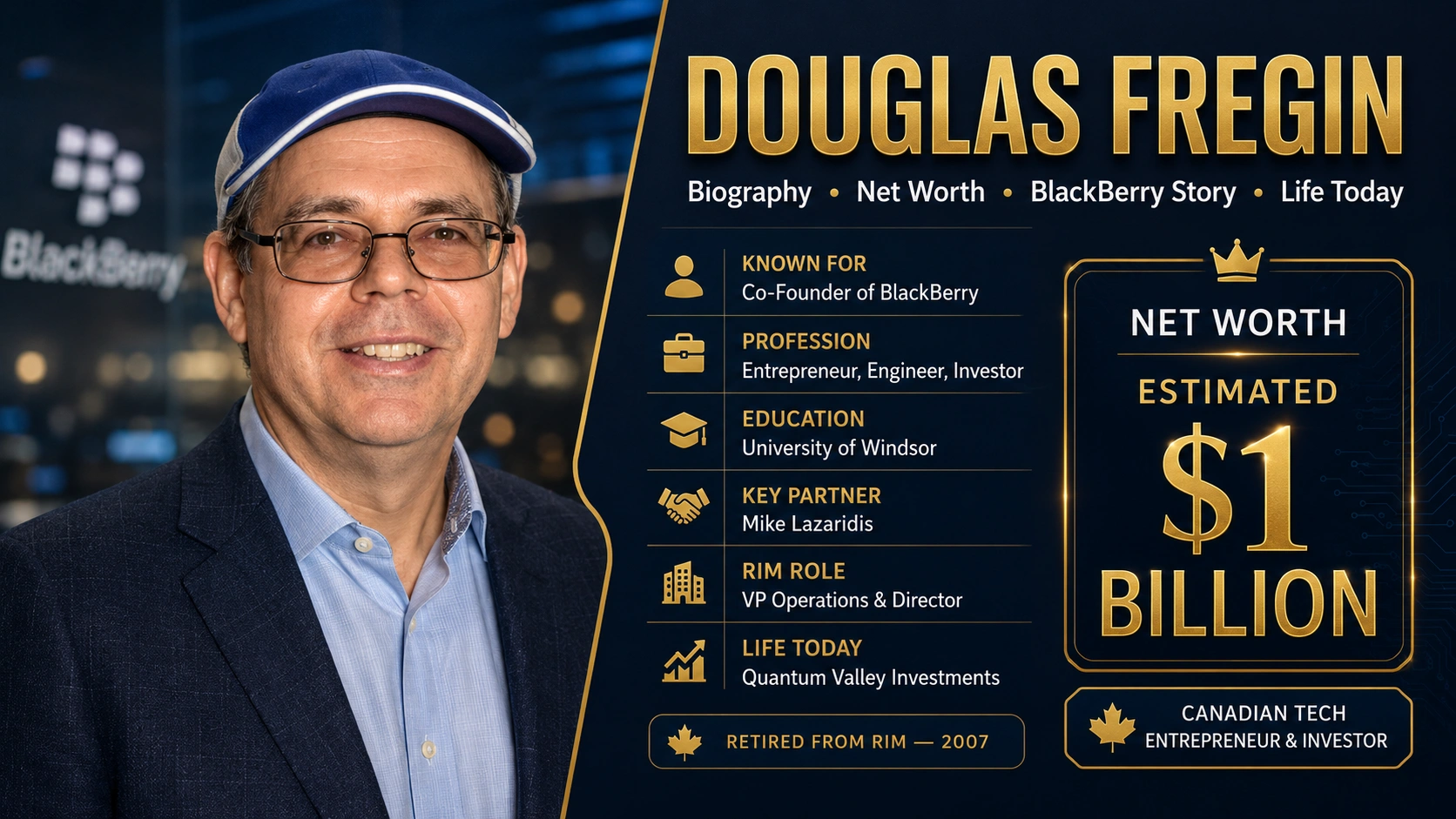
Douglas Fregin is a Canadian entrepreneur, electrical engineer, technology investor, and BlackBerry co-founder best known for helping create Research In Motion, the company that later became one of the most important names in mobile communication. While names like Mike Lazaridis and Jim Balsillie often get more public attention, Fregin played a key role behind the scenes in the early growth of RIM, the company behind the BlackBerry smartphone.
For many people, the search for Douglas Fregin biography starts with a simple question: who is Douglas Fregin? The short answer is that he was one of the original builders of Research In Motion, served as Vice President of Operations and a Director of RIM, and later became connected to Quantum Valley Investments, a fund focused on advanced technologies such as quantum computing. His story is also closely tied to BlackBerry’s rise and fall, his estimated wealth, and renewed interest from the 2023 BlackBerry movie, where he was portrayed by Matt Johnson.
Douglas Fregin Quick Facts
| Fact | Detail |
| Full name | Douglas Fregin, also known as Doug Fregin |
| Known for | Co-founding Research In Motion / BlackBerry |
| Profession | Entrepreneur, electrical engineer, technology investor |
| Education | University of Windsor |
| Major company | Research In Motion, later known as BlackBerry Limited |
| Key partner | Mike Lazaridis |
| RIM role | Vice President of Operations and Director |
| Retirement from RIM | 2007 |
| Post-RIM work | Quantum Valley Investments |
| Main industries | Wireless communication, smartphones, quantum technologies |
Fregin is often described as a low-profile entrepreneur because he has stayed away from the public spotlight more than many other tech founders. This privacy is one reason readers often search for Douglas Fregin facts, Douglas Fregin net worth, and what Douglas Fregin is doing now.
Early Life, Education, and Friendship With Mike Lazaridis
Douglas Fregin’s story is closely connected to Mike Lazaridis, his childhood friend and future business partner. According to Quantum Valley Investments, Fregin and Lazaridis had been close friends since grade 5, long before they became major names in Canadian technology.
Fregin studied electrical engineering at the University of Windsor, which helped shape his technical thinking. This background matters because Research In Motion did not begin as a famous smartphone company. It started as a small technology business built around engineering, wireless communication, and practical problem-solving.
Before the world knew BlackBerry as a business phone, Fregin and Lazaridis were already interested in electronics and innovation. Their early friendship became the foundation for one of Canada’s most important technology partnerships. This is why any strong Douglas Fregin biography must explain not only his business success, but also the long relationship that helped lead to Research In Motion.
How Douglas Fregin Helped Found Research In Motion
Douglas Fregin Research In Motion searches usually focus on one key fact: Fregin and Mike Lazaridis co-founded Research In Motion Limited in 1984. The company later created the BlackBerry wireless device, which changed business communication around the world.
In simple terms, Research In Motion began as a small Canadian technology company focused on wireless systems and communication tools. It was not an overnight success. The company had to build products, develop technical skills, and find markets before BlackBerry became a global brand.
One important early detail is that RIM received a $15,000 Ontario New Ventures loan in February 1985, which helped support the young company during its beginning stage. That kind of small early funding shows how far the company eventually traveled—from a local Canadian startup to a worldwide name in mobile email and secure communication.
Fregin’s role was not just symbolic. Competitor sources and official profiles connect him with practical operations, technical evaluation, and early company development. He was part of the foundation that allowed RIM to move from experiments and early products into the larger mobile communication industry.
Douglas Fregin’s Role at BlackBerry and RIM
A common user question is: what was Douglas Fregin’s role at BlackBerry? The clearest answer is that he helped build and operate the company during its most important early years. His official Quantum Valley Investments profile states that he served as Vice President of Operations and as a Director of RIM until retiring in 2007.
His role included more than management. Fregin was reportedly important in evaluating materials and supporting the technical side of RIM’s work. Wikipedia also notes that he played a vital role in designing initial circuit boards used in the company’s wireless technology.
That makes his contribution different from someone who only invested money or held a title. Fregin helped with the practical building blocks of the business. In the early days of wireless communication, hardware decisions, product reliability, and operational discipline were extremely important. BlackBerry later became famous for secure mobile email, corporate communication, and devices that business users trusted.
So, when people search Douglas Fregin contribution to BlackBerry, the best answer is this: he was a technical and operational co-founder who helped RIM build the foundation that made the BlackBerry smartphone possible.
Douglas Fregin, Mike Lazaridis, and Jim Balsillie: Who Did What?
One reason Douglas Fregin is sometimes misunderstood is that the BlackBerry story includes several major figures. A simple comparison helps explain the difference.
| Person | Main Role | Simple Explanation |
| Douglas Fregin | Co-founder, operations, technical support | Helped build and run RIM behind the scenes |
| Mike Lazaridis | Co-founder, technology visionary | Led much of the company’s engineering direction |
| Jim Balsillie | Business executive | Helped scale sales, strategy, and global growth |
Fregin and Lazaridis were the original co-founders of RIM in 1984, while Balsillie later became one of the best-known business figures connected to BlackBerry’s expansion.
This comparison also explains why Fregin is less famous. Lazaridis is often remembered as the engineering visionary, and Balsillie became a more public business personality. Fregin, meanwhile, stayed more private and worked in a less public-facing role. But a behind-the-scenes role does not mean a small role. Many successful technology companies depend on people who quietly solve operational, technical, and product problems before the public ever sees the result.
Douglas Fregin Net Worth and BlackBerry Fortune Explained
Douglas Fregin net worth is one of the most searched topics connected to his name. Public wealth estimates vary because Fregin is a private person and because his wealth has been linked to changing values of RIM stock and BlackBerry shares.
Forbes listed Douglas Fregin on its billionaire profile and noted that he co-founded Research In Motion with childhood friend Mike Lazaridis in 1984. Other public profiles and wealth-focused articles have described him as a billionaire entrepreneur or Canadian tech billionaire, largely because of his ownership in RIM during BlackBerry’s peak years.
The important point is that his fortune came mainly from his connection to Research In Motion. When RIM grew, the value of his stake grew. Wikipedia states that when RIM went public in 1997, Fregin’s 5% ownership stake was valued at about $23.6 million. By 2005, his 2.7% ownership stake was valued at around $396 million, and when he retired in May 2007, his 2% stake was valued around $1.3 billion.
A careful article should not treat every net worth number as exact. Wealth estimates can change because of taxes, investments, private assets, stock sales, and market movement. Still, it is fair to say that Douglas Fregin became wealthy because he helped create one of the most successful technology companies in Canadian history.
Did Douglas Fregin Sell His BlackBerry Shares at the Right Time?
Another popular angle is whether Douglas Fregin sold his BlackBerry shares at the right time. This topic attracts attention because BlackBerry’s story changed dramatically after the iPhone launch.
Apple introduced the first iPhone on January 9, 2007, and Fregin retired from RIM in May 2007. Some wealth-focused articles describe him as a founder who “cashed out” at a very strong moment, before BlackBerry’s later decline became severe.
This does not mean every detail of his stock sales is simple or public. But the larger business lesson is clear: timing matters. BlackBerry was still powerful in the business phone market when the iPhone arrived, but the touchscreen world changed what many consumers expected from a smartphone. Over time, Apple and Android devices reshaped the market.
Fregin’s timing became part of his public story because he left RIM before the company’s most difficult years. That is why search terms like Douglas Fregin iPhone timing, Douglas Fregin sold BlackBerry stock, and Douglas Fregin preserved his billionaire status appear around his name.
Awards, Innovation, and Technical Recognition
Douglas Fregin’s story is not only about BlackBerry phones and personal wealth. RIM also worked on other technologies, including the DigiSync Film KeyKode Reader, a tool connected to film editing and post-production.
In 1994, Fregin, along with Eastman Kodak and the National Film Board of Canada, received a Technology and Engineering Emmy Award for the development of a Keycode Reader. This detail is important because it shows that RIM’s early technical work had value beyond mobile phones.
For readers, this adds depth to the Douglas Fregin biography. He was not only connected to the BlackBerry device. He was also part of a technical culture that built real tools, solved real problems, and earned recognition from respected institutions.
This type of recognition also supports the idea that Fregin’s contribution was practical. He was involved in a company that produced technology with measurable value, long before BlackBerry became a global business symbol.
Douglas Fregin and the BlackBerry Movie
The Douglas Fregin BlackBerry movie connection created new public interest in his life. In the 2023 biographical film BlackBerry, Fregin was portrayed by Matt Johnson, who also directed the film.
The movie focuses on the rise and fall of Research In Motion and the people behind it. However, viewers should understand that a film is not the same as a full biography. Movie characters are often dramatized to make the story more entertaining.
History vs. Hollywood notes that the real Doug Fregin did not match the movie’s headband-wearing character style, explaining that Matt Johnson’s character bears little resemblance to the real Fregin in that respect. This is important for anyone searching real Douglas Fregin BlackBerry movie or Douglas Fregin real person vs movie character.
The film is useful because it brought more attention to RIM’s history, but it should be treated as a dramatized story. To understand Fregin accurately, readers should look at his real business record: co-founder of RIM, operational leader, technical contributor, private investor, and important figure in Canadian technology history.
Why Douglas Fregin Is Less Famous Than Other BlackBerry Founders
A common question is why is Douglas Fregin private or why he is less famous than Mike Lazaridis and Jim Balsillie. The answer seems to be a mix of personality, role, and public visibility.
Fregin has long been described as having a low-profile nature. Wikipedia notes that he is known for being low-key and private. Unlike some founders who become public speakers, media personalities, or business celebrities, Fregin appears to have preferred a quieter path.
His role at RIM also helped shape that image. Operations and technical work are often less visible than sales, public strategy, or CEO-level decision-making. A person can be deeply important to a company’s success without becoming the face of the brand.
This private public image is part of what makes him interesting. Douglas Fregin is a strong example of a quiet tech founder—someone whose work shaped a major company, even though he did not build a public identity around fame.
What Is Douglas Fregin Doing Now?
Many readers want to know what Douglas Fregin is doing now. After leaving RIM, he continued to work in technology and investment, especially through Quantum Valley Investments.
Quantum Valley Investments says Fregin co-founded the Quantum Valley Investments Fund in March 2013 with Mike Lazaridis. The fund focuses on supporting the commercialization of quantum technologies.
This post-BlackBerry work is important because it shows that Fregin’s career did not end with RIM. Instead, he remained connected to advanced technology, especially in Waterloo, Ontario, a region strongly associated with Canadian innovation.
Quantum computing is different from the smartphone business, but the pattern is familiar: invest in difficult technology early, support strong technical teams, and help build long-term value. For someone known for helping create RIM, a move into quantum technology fits his background as a technically minded entrepreneur and investor.
So, while Fregin may not be a loud public figure, his name remains connected to serious technology work through Quantum Valley Investments, Waterloo’s tech ecosystem, and Canada’s broader innovation story.
Douglas Fregin’s Role in Canadian Technology History
Douglas Fregin matters because BlackBerry was not just another phone brand. At its peak, BlackBerry shaped how executives, professionals, governments, and companies communicated. It helped make mobile email and secure business communication normal before modern smartphones became common.
Research In Motion was founded in Waterloo, Ontario, and BlackBerry Limited is still associated with Waterloo. That connection helped make the region one of Canada’s most recognized technology hubs.
Fregin’s role in Canadian technology history includes several layers. He helped co-found RIM. He contributed to early technical and operational work. He became part of the BlackBerry wealth story. He supported later deep-tech investment through Quantum Valley. He also contributed to Canada’s image as a place where major technology companies and advanced research can grow.
In simple terms, Douglas Fregin BlackBerry searches are not only about one person. They are also about the history of Canadian innovation, the rise of enterprise mobility, and the changing smartphone industry.
Douglas Fregin Career Timeline
| Year / Date | Event |
| 1984 | Douglas Fregin and Mike Lazaridis co-founded Research In Motion. |
| February 1985 | RIM received a $15,000 Ontario New Ventures loan. |
| 1994 | Fregin, Eastman Kodak, and the National Film Board of Canada received a Technology and Engineering Emmy Award for a Keycode Reader. |
| 1997 | RIM went public, and Fregin’s ownership stake was valued at about $23.6 million. |
| 2000 | Fregin donated $10 million to help found the Perimeter Institute for Theoretical Physics. |
| May 2007 | Fregin retired from RIM. |
| March 2013 | Fregin and Lazaridis co-founded Quantum Valley Investments Fund. |
| 2023 | Public interest grew again through the BlackBerry movie. |
This timeline shows why Douglas Fregin is more than a footnote. His career connects early engineering, company building, wealth creation, philanthropy, film attention, and long-term technology investment.
Frequently Asked Questions About Douglas Fregin
Who is Douglas Fregin?
Douglas Fregin is a Canadian entrepreneur and electrical engineer best known as a co-founder of Research In Motion, the company behind BlackBerry. He co-founded RIM with his childhood friend Mike Lazaridis in 1984.
What is Douglas Fregin’s net worth?
Public estimates vary, but Douglas Fregin has often been described as a billionaire or former billionaire because of his ownership in RIM / BlackBerry shares. Forbes listed him in connection with its billionaire profile, and other public sources have connected his wealth to RIM’s stock value.
What was Douglas Fregin’s role at BlackBerry?
Fregin served as Vice President of Operations and Director of RIM until his retirement in 2007. He was also connected to early technical work, including materials evaluation and circuit board development.
Did Douglas Fregin co-found Research In Motion?
Yes. Douglas Fregin and Mike Lazaridis co-founded Research In Motion Limited in 1984. RIM later created the BlackBerry wireless device, which became a major product in the global communications industry.
Who played Douglas Fregin in the BlackBerry movie?
Douglas Fregin was played by Matt Johnson in the 2023 film BlackBerry. Johnson also directed the movie.
What is Douglas Fregin doing now?
Fregin is connected to Quantum Valley Investments, which he co-founded with Mike Lazaridis in March 2013. The fund focuses on the commercialization of quantum technologies.
Why is Douglas Fregin not as famous as Mike Lazaridis?
Douglas Fregin is less famous mostly because he has kept a low public profile and worked more behind the scenes. Lazaridis and Balsillie became more visible public figures in the BlackBerry story, while Fregin remained more private.
Conclusion: Why Douglas Fregin Still Matters
Douglas Fregin still matters because he helped build one of the most important technology companies in Canadian history. As a BlackBerry co-founder, he played a real role in the creation and growth of Research In Motion, a company that changed mobile communication before the modern smartphone era took over.
His story includes engineering, operations, wealth, privacy, innovation, and long-term investment. He was not the loudest figure in the BlackBerry story, but his contribution was important. From RIM’s early circuit boards to Quantum Valley Investments, Fregin’s career shows how quiet founders can shape industries without becoming public celebrities.
For readers searching Douglas Fregin biography, Douglas Fregin net worth, Douglas Fregin BlackBerry, or what Douglas Fregin is doing now, the key takeaway is simple: he is a private but highly influential Canadian technology figure whose legacy goes far beyond one famous smartphone brand.
Disclaimer
This article is for general informational purposes only. Details, estimates, opinions, and individual situations may vary, so readers should use the information as a helpful overview rather than a final source.