
 By adnanshabbir942@gmail.com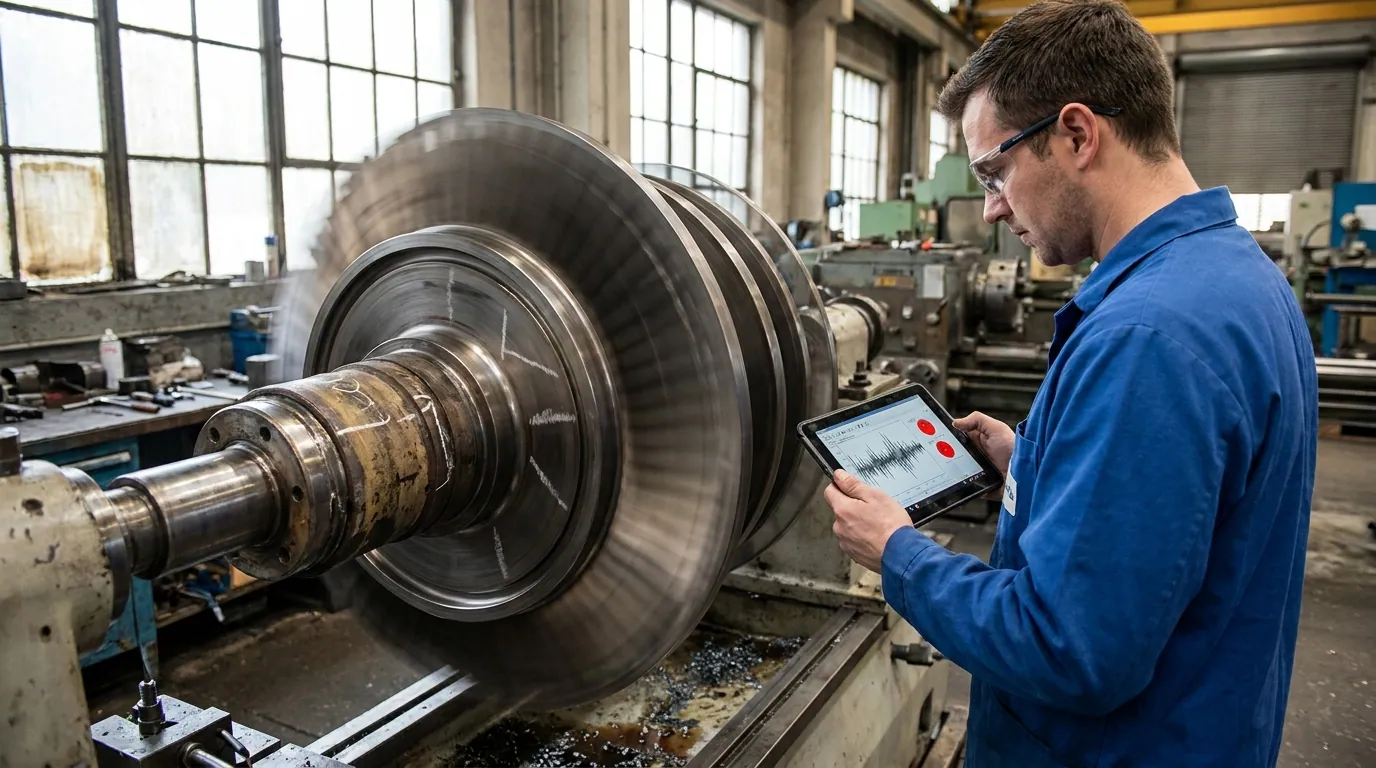
Introduction
The dynamic unbalance in mechanical systems refers to a condition in which the mass distribution of a rotating part is uneven in such a way that the part creates vibration during rotation and usually needs correction in two planes rather than one. In simple words, a rotor may look fine when it is still, but once it starts spinning, the center of mass, shaft axis, and principal inertia axis do not line up the way they should. That mismatch creates dynamic force in rotating systems, which leads to excess vibration, noise, bearing wear, and lower operational efficiency.
This topic matters in every field that depends on rotating machinery, from fans, pumps, and turbines to crankshafts, compressors, motors, and even everyday items like washing machine drums and ceiling fan blades. If left alone, dynamic unbalance can increase maintenance costs, shorten bearing life, damage seals, and raise the risk of downtime or even catastrophic failure.
To understand what is dynamic unbalance, it helps to compare it with static unbalance and couple unbalance, then look at how engineers use vibration analysis, FFT spectrum, phase information, balancing machines, and two-plane balancing to find and fix the problem.
What Is Dynamic Unbalance?
Dynamic unbalance is a type of rotor unbalance that appears when a rotating component has an uneven mass distribution along its length. In engineering terms, it exists when the principal inertia axis of the rotor is not properly aligned with the shaft axis or axis of rotation. Because of that, the rotor generates forces while spinning, and those forces show up as vibration, heat and noise, and extra stress on the machine.
A simple dynamic unbalance definition is this: it is the unbalance that becomes obvious during rotation, especially when the rotor needs correction in 2 planes or 2 or more planes. That is why many technicians say dynamic unbalance is the most common type of unbalance found in rotors. It is not just a “heavy spot” problem in one location. It is often a more complex specific combination of static and couple unbalance.
This is why the phrase “the dynamic unbalance in mechanical systems refers to” usually points to more than a basic imbalance. It refers to a condition where a rotor’s center of gravity, center of mass, or mass axis is not behaving correctly relative to the center of rotation and rotational axis. The result is a rotating object that may seem acceptable at rest but produces rotational unbalance at operating speed.
You can think of it like this: if the rotor has eccentric mass distribution, the machine feels that error more strongly the faster it spins. That is why rotational speeds, natural frequency, and operating speed matter so much in vibration diagnostics and machine vibration troubleshooting.
How Dynamic Unbalance Differs From Static and Couple Unbalance
To understand dynamic unbalance vs static unbalance and dynamic unbalance vs couple unbalance, it helps to compare all 3 types of unbalances side by side.
| Type of Unbalance | What It Means | Typical Correction | Key Behavior |
|---|---|---|---|
| Static unbalance | One heavy point causes the rotor to settle in one position | One-plane balancing | Visible even when the rotor is not spinning |
| Couple unbalance | Equal unbalance forces act in different planes, often 180° opposite each other | Usually needs two-plane balancing | Creates a rocking or twisting effect |
| Dynamic unbalance | A combined condition involving static unbalance and couple unbalance | Requires two-plane balancing or multiplane balancing | Appears clearly during rotation |
Static unbalance is the easiest to picture. Imagine a simple disc with one heavy point. If you place it on low-friction supports, the heavy point drops to the bottom. That is a classic one-plane balancing issue.
Couple unbalance is different. The rotor may have two heavy points in separate correction planes. Those forces do not always show up as a simple heavy side. Instead, they create a turning or rocking effect. This is why couple balancing usually needs correction in more than one plane.
Dynamic unbalance combines the complexity of both. It is often described as dynamic unbalance is a combination of static and couple unbalance. In many practical cases, a rotor shows a mix of lateral unbalance, mass eccentricity, and axial distribution errors. That is why a single correction is often not enough. A single correction may reduce the problem, but it may not bring the machine to the required tolerance.
This is also why static vs dynamic balancing is such an important concept in real maintenance work. A rotor that passes a simple static check may still produce severe vibration at operating speed because its central principal axis of inertia neither stays parallel to nor intersects the shaft axis correctly at the center of mass.
What Causes Dynamic Unbalance in Mechanical Systems?
Several things can cause dynamic imbalance in rotating machinery. Some begin at manufacturing, while others develop slowly during operation.
One common cause is manufacturing defects or manufacturing imperfections. If a rotor is not machined evenly, the mass of rotor, radius of rotor, and distance to center of gravity can create unwanted mass eccentricity. Small dimensional errors can become a big issue once speed increases.
Another major cause is uneven wear. Over time, rotor bearings, seals, and rotating surfaces wear differently. That can change the center of gravity and create rotating mass imbalance. Bent shafts, replacement part issues, and poor repair work can make the problem worse.
In industrial settings, thermal growth, temperature variations, and heat distortion are also important. A rotor may behave one way when cold and another when hot. This explains why some machines show dynamic imbalance caused by thermal growth only after running for a while.
Material changes matter too. Material buildup, uneven material removal, corrosion, dirt accumulation, and missing hardware can all shift the rotor mass. A fan with dust buildup, a pump with deposits, or a coupling with missing balance weights can quickly develop dynamic unbalance in rotors and dynamic unbalance in shafts.
Assembly problems are another hidden cause. Even well-made components can become unbalanced because of assembly issues, incorrect orientation, poor fit-up, or bad positioning of weights, keys, and couplings. In short, what causes rotor unbalance is not one thing. It is often a chain of small mechanical errors that combine into one serious vibration problem.
Common Symptoms and Effects of Dynamic Unbalance
The symptoms of dynamic unbalance usually start with excess vibration. Operators may notice shaking, humming, or a machine that feels rough at speed. Over time, that vibration spreads damage through the system.
The first visible sign is often noise. Then comes heat, friction, and increased stress on bearings and supports. If the condition continues, the machine may suffer premature bearing failure, seal damage, loose fasteners, cracked supports, or structural damage. In severe cases, the result can be catastrophic failure.
Dynamic unbalance also affects business performance. It raises maintenance costs, reduces product quality, harms reliability, and increases downtime. In plants that depend on high-speed rotating equipment, unbalance can create serious safety hazards and affect compliance with internal reliability standards.
Here is a simple view of the usual impact:
| Symptom | Likely Effect |
|---|---|
| Excess vibration | Faster wear of bearings and supports |
| Heat and noise | Reduced efficiency and operator concern |
| Heavy spot behavior | More unbalance force during rotation |
| Seal damage | Leakage and repair costs |
| Downtime | Lower production and higher operating cost |
A useful rule in maintenance is this: dynamic unbalance and bearing life are closely linked. The more the machine runs with unbalance, the more the bearing load increase can shorten service life.
Why Dynamic Unbalance Produces Vibration During Rotation
Many people understand that unbalance creates vibration, but fewer understand why. The answer lies in centrifugal force due to unbalance.
When a rotor spins, any uneven mass creates a force that pulls outward from the axis of rotation. If the rotor mass is not evenly distributed, the machine experiences a repeating unbalance force once every revolution. This is why technicians often talk about 1X vibration, meaning vibration at the machine’s running speed.
The faster the speed, the stronger the force. That is why even a small amount of eccentric mass distribution can create major vibration at high rpm. The force changes the amplitude, interacts with machine stiffness, and can become worse near the natural frequency. If resonance enters the picture, vibration can rise sharply.
A practical training line often used in industry is:
“Unbalance is small in geometry but large in force once speed multiplies it.”
That idea captures the core of mechanical systems vibration. The physical error may look minor, but at speed it becomes a serious dynamic force in rotating systems.
How Dynamic Unbalance Is Measured and Diagnosed
To identify dynamic unbalance in machinery, engineers rely on vibration analysis, speed-related measurements, and balancing tools. One of the most common approaches is to collect vibration data using accelerometers or laser sensors, then study the results through FFT spectrum, frequency, and phase angle.
The most important clues are usually found at running speed. If the machine shows strong 1X vibration, with stable phase and speed-related response, dynamic unbalance becomes a likely suspect. This is where phase information matters. Amplitude alone is not enough. Phase helps show where the heavy effect appears and how it behaves across planes.
Technicians also use balancing machines, including vertical dynamic balancing machine setups, horizontal dynamic balancing machine setups, and sometimes soft type dynamic balancing machine or hard type dynamic balancing machine designs depending on the application. These systems calculate the mass of weight, correction mass, angle, and location needed to reduce the unbalance.
In field work, a smart balancer or portable system may be used while the machine is running. The technician may apply a trial weight method, observe changes in vibration and phase, and then calculate the final correction.
This process is important because dynamic unbalance corrected in 2 or more planes requires more than guesswork. It requires measured data, careful placement of weight, and confirmation that the machine has reached the required tolerance or permissible unbalance for its service.
How Dynamic Unbalance Is Corrected
When people ask how is dynamic unbalance corrected, the answer usually comes down to dynamic balancing. In most cases, dynamic unbalance can only be corrected in two or more planes because the problem exists along the rotor length, not just in one flat disc location.
The correction process begins by measuring vibration and phase in each plane. Then technicians decide whether to add correction weight or remove material. Common methods include drilling, grinding, milling, welding, bolting, using weighted clips, or attaching a small mass with an industrial adhesive or balance putty.
A simplified correction flow looks like this:
- Measure the baseline vibration.
- Add a known trial weight in one correction plane.
- Re-measure amplitude and phase.
- Repeat in the second plane.
- Calculate final correction weight and angle.
- Verify the result at operating speed.
This is why two-plane balancing is such a core term in the rotor-balancing world. For longer rotors, multiplane balancing for flexible rotors may be needed. In very advanced work, engineers may consider auxiliary planes, internal bending stresses, and pre-balanced operation in auxiliary planes.
A short practical case study makes this clearer. Imagine an industrial fan showing high vibration after maintenance. A simple static check finds nothing unusual. Field testing then shows strong running-speed vibration with unstable phase between two ends of the shaft. The team applies a trial weight method in two planes, recalculates the needed mass, and reduces vibration to an acceptable level. In that case, dynamic unbalance was present even though the rotor did not behave like a simple static heavy spot.
Dynamic Balancing vs Field Balancing
Although many people use the terms loosely, dynamic balancing and field balancing are not always the same thing. Dynamic balancing refers to the balancing method itself, especially when correction is based on rotating behavior in multiple planes. Field balancing or in-situ balancing refers to where the work is done: on the machine, in its installed condition.
Shop balancing is often more controlled. The rotor is removed and tested on dedicated balancing machines. Field balancing, by contrast, happens in the real operating environment. That can be useful because it includes the effects of couplings, mounted components, and real support conditions.
For rigid rotor balancing, shop work may be enough. For flexible rotor balancing or complex systems, field methods may reveal issues that the shop cannot fully reproduce. This is why rotor balancing methods should be chosen based on machine type, access, and operating behavior.
Real-World Examples of Dynamic Unbalance
A good dynamic unbalance example helps make the idea easy to remember. Consider a ceiling fan blade with uneven dust buildup. At low speed the effect may be small, but at higher speed the fan starts shaking and making noise. That is a simple everyday case.
Now think bigger. Dynamic unbalance in fans, dynamic unbalance in pumps, and dynamic unbalance in turbines is much more serious because the equipment runs faster, carries heavier loads, and operates longer hours. The same goes for crankshafts, driveshafts, compressors, propellers, and motor rotors.
Even household machines show the same physics. A washing machine drum with uneven load distribution can vibrate violently during spin. In industry, the same principle applies to pump rotors, fly wheels, brake discs, clutches, and small electrical armatures.
The lesson is simple: whether the rotor is inside automotive, aerospace, or industrial machinery, the physics of dynamic unbalance in mechanical systems stays the same.
Standards, Tolerances, and Balance Quality Grades
Professional balancing work often refers to ISO 21940, which covers balancing terminology, methods, and balance quality grade concepts. These standards help define what level of residual unbalance is acceptable for a given machine type and operating speed.
You may see values such as G Grade 40 or Grade 2.5. These are not random labels. They help engineers match balancing quality to the machine’s application. A rough machine can tolerate more unbalance than a precision high-speed unit.
Units such as gram-millimetres, gram-centimetres, gram-inches, and ounce-inches are also common when expressing unbalance quantity. They give a measurable way to discuss permissible unbalance, correction size, and acceptance limits.
Even if a general reader does not need full formulas, including these balancing standards and ISO balancing standards adds trust and authority to the discussion.
Dynamic Unbalance vs Misalignment and Resonance
A common troubleshooting mistake is to confuse misalignment vs unbalance or resonance vs unbalance. All three can cause vibration, but they do not behave the same way.
Unbalance usually shows strong running-speed response and often improves with correction mass. Misalignment may create vibration patterns linked to couplings, offset shafts, or angular errors. Resonance happens when forcing frequency meets the machine’s natural frequency, which can sharply amplify vibration.
This is why machine vibration troubleshooting should never rely on one symptom alone. Good diagnosis uses vibration analysis, phase, frequency, speed checks, and mechanical inspection together.
Dynamic Unbalance and Predictive Maintenance
Modern plants do not want to wait for failure. That is why predictive maintenance and condition monitoring matter so much. By tracking vibration trends, speed changes, and 1X vibration behavior over time, reliability teams can detect dynamic unbalance before it causes major damage.
This improves machine reliability engineering, reduces downtime, and supports better maintenance and reliability planning. Instead of reacting to broken bearings or cracked supports, teams can correct the issue early and protect operational efficiency.
Frequently Asked Questions About Dynamic Unbalance
What does dynamic unbalance mean in simple words?
It means a rotating part has uneven mass in a way that creates vibration during rotation, often needing two-plane balancing.
Is dynamic unbalance the same as static unbalance?
No. Static unbalance is usually a one-plane heavy-point issue. Dynamic unbalance is more complex and often includes both static and couple unbalance.
Why does dynamic unbalance require two-plane balancing?
Because the error exists along the rotor length, not just at one point. One correction plane often cannot remove the full effect.
Can dynamic unbalance damage bearings?
Yes. It increases loads, shortens bearing life, and can lead to premature bearing failure.
How do you test for dynamic unbalance?
Technicians use vibration analysis, FFT spectrum, phase information, accelerometers, laser sensors, and balancing machines.
Can field balancing fix dynamic unbalance?
Yes, in many cases field balancing is an effective way to correct it, especially when the rotor behaves differently in real operating conditions.
Conclusion
Understanding dynamic unbalance is essential for anyone working with rotating equipment. At its core, the problem is simple: uneven mass distribution creates force during rotation. But the effects are serious, from excess vibration and noise to bearing wear, lower reliability, and costly downtime.
The best way to approach the issue is to define it clearly, separate it from static unbalance and couple unbalance, diagnose it with proper vibration diagnostics, and correct it using dynamic balancing, two-plane balancing, or multiplane balancing when needed. When that is done well, machines run smoother, safer, and longer.
Disclaimer: