
 By adnanshabbir942@gmail.com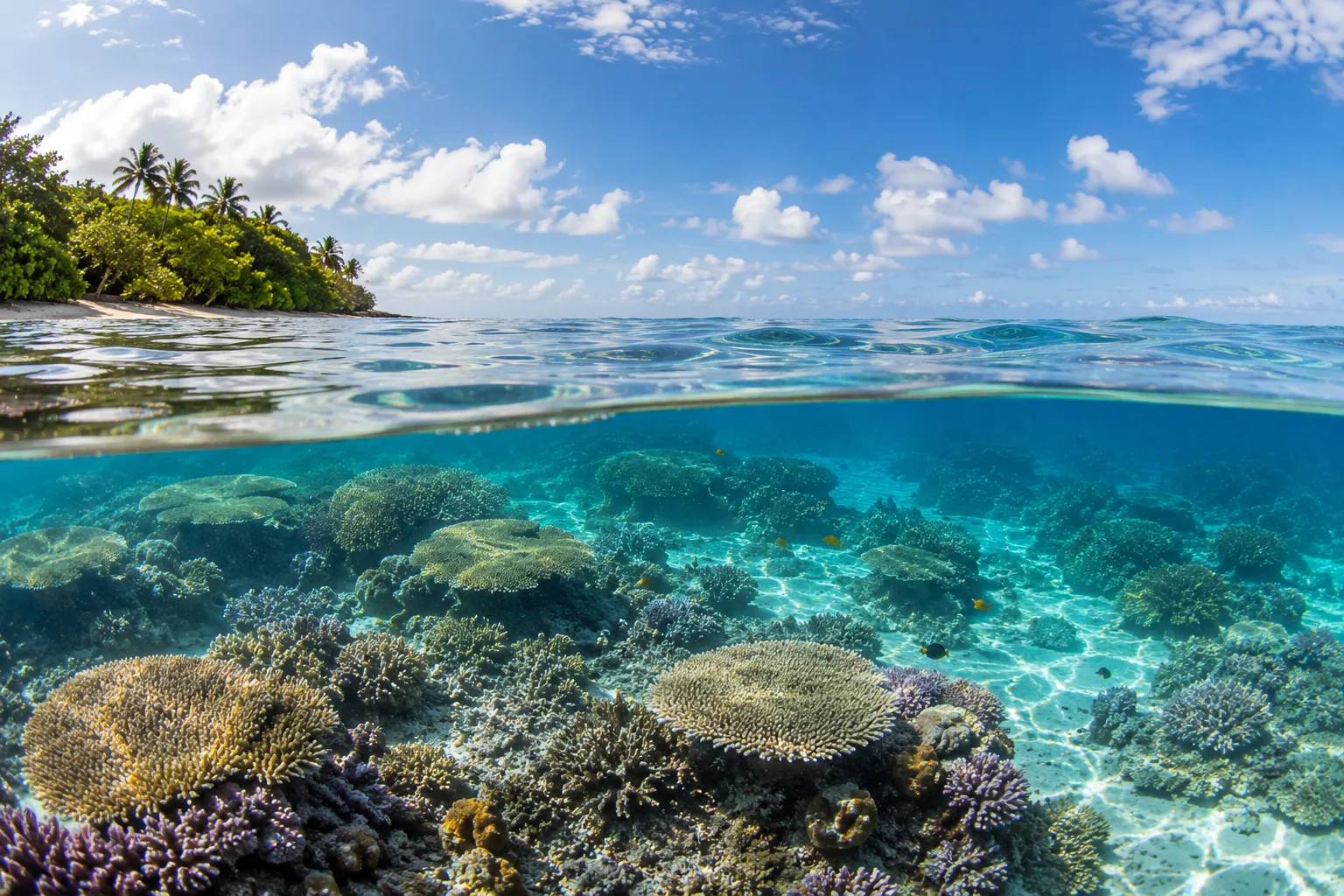
The defining abiotic features are the non-living physical and chemical conditions that allow coral reefs to form, grow, and support life. These include warm water temperature, stable salinity, sunlight, shallow depth, clear water, low turbidity, water movement, low nutrient levels, dissolved gases, pH, carbonate chemistry, calcium carbonate availability, aragonite saturation, and hard substrate.
In simple terms, coral reefs are not shaped only by living organisms like corals, algae, reef fish, sponges, and zooxanthellae. They are also shaped by the surrounding abiotic environment. If the water becomes too hot, too cloudy, too fresh, too polluted, or too acidic, the reef can become stressed. NOAA explains that reef-building corals usually need warm, salty water, with many growing best between 73°F and 84°F / 23°C–29°C, and salinity commonly ranging from 32 to 42 parts per thousand.
Understanding these coral reef abiotic factors helps explain why reefs are usually found in shallow tropical seas, why they need sunlight, and why changes such as coral bleaching, ocean acidification, and sedimentation can damage reef ecosystems.
What Are Abiotic Features in a Coral Reef Biome?
Abiotic features are the non-living components of an ecosystem. In a coral reef biome, these include things like water temperature, sunlight, salinity, pH, waves, currents, sediment, oxygen, nutrients, water clarity, and depth.
These factors are different from biotic factors, which are the living parts of the reef, such as coral polyps, zooxanthellae, algae, fish, mollusks, crustaceans, sea turtles, and marine organisms. Both biotic and abiotic factors work together, but abiotic factors set the environmental limits. They determine where coral reefs can form, how fast corals can grow, and whether the reef can survive long term.
For example, coral animals are living organisms, but the saltwater, sunlight, and carbonate chemistry around them are abiotic. A coral reef ecosystem needs all of these conditions to stay balanced. If one major abiotic feature changes too much, the whole system can be affected.
That is why the question “what are the defining abiotic features of coral reef biomes” is really asking: what non-living conditions make coral reefs possible?
The answer is not just one factor. Coral reefs depend on a stable combination of warm water, clear shallow seas, strong light penetration, suitable salinity, moderate water movement, low sediment, healthy pH, and enough calcium carbonate minerals for reef-building corals to create skeletons.
Quick Table: Defining Abiotic Features of Coral Reef Biomes
| Abiotic Feature | Role in Coral Reef Biomes | Why It Matters |
| Warm water temperature | Supports coral metabolism and reef growth | Extreme heat can cause thermal stress and bleaching |
| Stable salinity | Keeps coral tissues in balance | Too much freshwater or salt causes osmotic stress |
| Sunlight | Powers photosynthesis in zooxanthellae | Explains why many reefs grow in shallow water |
| Shallow depth | Allows light to reach corals | Light decreases as depth increases |
| Clear water | Improves light penetration | Cloudy water reduces photosynthesis |
| Low turbidity | Limits suspended particles and sediment | Sediment can block light and smother coral |
| Waves and currents | Move oxygen, nutrients, and waste | Water movement shapes reef structure |
| Low nutrients | Helps prevent algal overgrowth | Too many nutrients can favor algae over corals |
| pH and carbonate chemistry | Support coral skeleton formation | Acidification makes calcification harder |
| Calcium carbonate and aragonite | Build coral skeletons and reef framework | Essential for reef growth |
| Dissolved gases | Include oxygen (O2) and carbon dioxide (CO2) | Affect respiration and seawater chemistry |
| Hard substrate | Gives coral larvae a place to attach | Needed for reef formation |
This table shows why coral reefs are sensitive ecosystems. They need the right physical and chemical factors, not just the presence of coral animals. The Living Oceans Foundation describes coral reef environmental conditions such as light, depth, water movement, temperature, salinity, turbidity, nutrients, dissolved gases, aragonite, calcium carbonate saturation, and substrate as important abiotic factors.
Warm Water, Salinity, and Sunlight: The Big Three Abiotic Features
The three most recognized abiotic factors in coral reefs are temperature, salinity, and sunlight. These conditions explain why reef-building corals are most common in warm, clear, tropical oceans.
Water temperature is one of the strongest controls on coral reef distribution. Most reef-building corals cannot survive in very cold water. NOAA states that reef-building corals cannot tolerate water temperatures below 64°F / 18°C, and many grow best between 73°F and 84°F / 23°C–29°C.
However, warmer is not always better. When ocean temperatures rise too high, corals experience thermal stress. This can lead to coral bleaching, a process where corals expel the symbiotic algae living in their tissues. NOAA explains that corals bleach when stressed by changes in conditions such as temperature, light, or nutrients.
Salinity is another defining abiotic feature. Coral reefs form in saltwater, not freshwater. Salinity is usually measured in parts per thousand, or ppt. NOAA notes that many reef-building corals require salty water ranging from 32 to 42 ppt. When storms, flooding, or river runoff suddenly lower salinity, corals can suffer salinity stress or osmotic stress because their tissues are adapted to stable marine conditions.
Sunlight is equally important because many shallow-water corals live with zooxanthellae, which are symbiotic algae inside coral tissues. These algae use sunlight for photosynthesis, producing energy that helps feed the coral. This relationship explains why many coral reefs are found in shallow areas where light can reach the seafloor.
Together, warm water, stable salinity, and sunlight create the foundation for tropical coral reef biomes.
Depth, Water Clarity, Turbidity, and Sediment
Coral reefs are usually associated with shallow water because sunlight becomes weaker with depth. Many reef-building corals need enough light for their symbiotic algae to photosynthesize. This is why coral reefs often develop in the euphotic zone, the sunlit layer of the ocean where photosynthesis can occur.
Depth alone is not the only issue. Water clarity also matters. Even shallow water may not support healthy reefs if it is too cloudy. Turbidity refers to the cloudiness of water caused by suspended particles, such as sediment, plankton, or pollution. High turbidity reduces light penetration, which can limit photosynthesis and slow coral growth.
The Living Oceans Foundation notes that reef-building corals can live at depths less than 230 feet / 70 meters, but are typically found around 98 feet / 30 meters, where light is more available.
Sediment is another important abiotic factor. A small amount of natural sediment may be normal, but too much sediment can harm reefs. It can cloud the water, block sunlight, and settle directly on coral tissue. When sediment covers coral, the coral may use energy to remove it instead of using that energy for growth, feeding, and reproduction.
Human activity can make this worse. Coastal development, dredging, deforestation, agriculture, and runoff can increase sediment entering reef waters. This creates a major water quality problem. In a coral reef biome, clear water and low sediment levels are not just nice conditions; they are defining requirements for reef health.
Waves, Currents, Nutrients, and Dissolved Gases
Waves, currents, and water movement are also abiotic features of coral reef ecosystems. They may seem less obvious than temperature or sunlight, but they strongly influence reef structure and survival.
Ocean currents help bring oxygen (O2), dissolved gases, and tiny food particles to the reef. They also help remove waste products and prevent stagnant water from building up around coral colonies. Gentle to moderate water movement supports coral health, while very strong wave surge or storms can break coral skeletons and damage the reef framework.
Waves also shape where corals grow. Some corals are adapted to high-energy reef edges, while others grow better in calmer lagoons. This is why hydrodynamics in coral reefs affects coral distribution, reef growth, and the types of organisms that live in different reef zones.
Nutrients are another important part of the abiotic environment. Coral reefs are often found in nutrient-poor water, which may seem surprising because reefs are highly biodiverse. The key is that coral reef ecosystems are very efficient at recycling nutrients. Corals, algae, bacteria, plankton, fish, and other reef organisms keep nutrients moving through the system.
However, too many nutrients can be harmful. High levels of nitrogen and phosphorus from agricultural runoff or sewage can cause algal growth. Algae can compete with corals for space and light. If the balance shifts too far, the reef may become dominated by algae instead of reef-building corals.
This means healthy coral reefs usually need clean water, balanced nutrients, good oxygen flow, and steady water movement.
pH, Carbonate Chemistry, Calcium Carbonate, and Aragonite
One of the most important but less obvious abiotic features of coral reef biomes is seawater carbonate chemistry. Reef-building corals create hard skeletons from calcium carbonate. Over time, these skeletons form the reef framework that supports many other marine organisms.
Aragonite is a form of calcium carbonate that corals use to build their skeletons. When seawater chemistry is favorable, corals can calcify more easily. Calcification is the process of building calcium carbonate skeletons. This process is central to coral reef growth, reef framework formation, and long-term net accretion, which means the reef is building faster than it is being broken down.
The problem is that ocean chemistry can change. When the ocean absorbs more carbon dioxide (CO2), seawater becomes more acidic. This is called ocean acidification. NOAA explains that ocean acidification is already affecting marine organisms such as corals that make hard shells and skeletons.
NOAA also identifies aragonite saturation state as a measure used to understand how easily aragonite dissolves in seawater. Aragonite is the calcium carbonate mineral that calcifying organisms like corals use to build skeletons.
When pH drops and carbonate chemistry becomes less favorable, corals may struggle to build and maintain skeletons. Smithsonian Ocean explains that acidification can slow new coral skeleton growth while also making existing skeletons more vulnerable to erosion.
This is why pH, carbonate ions, calcium carbonate saturation, and aragonite saturation are defining abiotic features of coral reef biomes. Without the right chemistry, corals cannot build reefs effectively.
Abiotic vs Biotic Factors in Coral Reef Biomes
A common student question is: are coral reefs biotic or abiotic? The answer is that a coral reef biome includes both.
Corals themselves are biotic because they are living animals. Reef fish, algae, seagrass, sponges, plankton, and bacteria are also biotic. But the conditions around them—such as temperature, sunlight, salt, waves, pH, oxygen, and sediment—are abiotic.
| Abiotic Factors | Biotic Factors |
| Water temperature | Coral polyps |
| Salinity | Zooxanthellae |
| Sunlight | Algae |
| Waves and currents | Reef fish |
| pH and carbonate chemistry | Sponges |
| Turbidity and sediment | Crustaceans |
| Nutrients | Seagrass |
| Dissolved oxygen | Marine organisms |
This distinction matters because coral reef survival depends on interactions between living and non-living parts. For example, sunlight is abiotic, but it supports zooxanthellae, which are biotic. Calcium carbonate is abiotic, but corals use it to build biotic structures that later become part of the reef framework.
So, when someone asks about abiotic features of coral reefs, they are asking about the environmental conditions that make reef life possible.
How Abiotic Stress Causes Coral Bleaching and Reef Decline
Abiotic features support coral reefs when they stay within a healthy range. But when they move outside that range, they become stressors.
The best-known example is coral bleaching. When water becomes too warm, corals may expel their symbiotic algae, causing them to lose color and much of their food supply. NOAA states that bleaching can happen when corals are stressed by changes in conditions such as temperature, light, or nutrients, and prolonged stress can lead to coral death.
Other abiotic stressors can also weaken reefs. Sudden salinity changes can create osmotic stress. High turbidity can reduce light penetration. Sedimentation can smother coral tissue. Too many nutrients can encourage algal overgrowth. Lower pH can reduce calcification. Strong storms and wave surge can physically break coral structures.
Modern climate change has made these stressors more serious. NOAA Coral Reef Watch tracks accumulated heat stress using Degree Heating Weeks, a measure connected to the timing and intensity of coral bleaching. NOAA also reported that from January 1, 2023 to September 30, 2025, bleaching-level heat stress affected about 84.4% of the world’s coral reef area, with mass bleaching documented in at least 83 countries and territories.
This shows why abiotic features are not just background conditions. They directly affect coral health, coral resilience, reef biodiversity, and reef survival.
How Humans Change Abiotic Conditions in Coral Reefs
Human activity can change the abiotic conditions of coral reef biomes in many ways. These changes often make reef environments less stable.
Greenhouse gas emissions contribute to ocean warming and ocean acidification. Warmer seas increase the risk of marine heatwaves and bleaching. More carbon dioxide in seawater changes pH and carbonate chemistry, making it harder for corals to build skeletons.
Land-based pollution is also important. Agricultural runoff can add nitrogen and phosphorus to reef waters. This can fuel algae and reduce coral growth. Coastal development can increase sedimentation, which clouds the water and lowers light availability. Sewage, plastics, chemicals, and industrial pollution can also harm water quality.
In regional examples, reefs such as the Great Barrier Reef, Florida Keys, Caribbean reefs, Red Sea reefs, and Coral Triangle reef ecosystems all depend on the same basic abiotic features, but local conditions vary. Some reefs experience more heat stress, while others face more sediment, nutrient pollution, or salinity extremes. The Persian Gulf, for example, is often discussed as a region where corals tolerate unusually warm and salty conditions compared with many tropical reef systems.
Protecting coral reefs therefore means protecting the abiotic environment as well as the living organisms. Reef conservation is not only about saving coral animals; it is also about maintaining clean water, stable salinity, suitable temperature, balanced nutrients, and healthy carbonate chemistry.
FAQs About Coral Reef Abiotic Features
What are the five major abiotic factors in coral reefs?
The five major abiotic factors often listed for coral reefs are water, temperature, sunlight, salt, and waves. A more complete answer also includes salinity, water clarity, depth, pH, nutrients, dissolved oxygen, carbonate chemistry, calcium carbonate, aragonite, currents, turbidity, and substrate.
Why do coral reefs need sunlight?
Coral reefs need sunlight because many reef-building corals contain zooxanthellae, which are symbiotic algae. These algae use sunlight for photosynthesis and help provide energy to the coral. This is why many tropical reefs grow in shallow, clear water.
Is coral biotic or abiotic?
Coral is biotic because it is a living animal. However, the coral reef biome also includes abiotic features such as temperature, salinity, sunlight, waves, sediment, pH, and oxygen.
Is ocean acidification an abiotic factor?
Yes. Ocean acidification is an abiotic chemical change because it affects seawater pH and carbonate chemistry. It can make it harder for corals to build calcium carbonate skeletons.
What conditions are necessary for coral reefs to form?
Coral reefs usually need warm, shallow, clear, salty water, enough sunlight, stable salinity, low sediment, moderate currents, suitable pH, and a hard substrate where coral larvae can attach. They also need enough calcium carbonate and aragonite saturation for skeleton formation.
Which abiotic factor is most important for coral reefs?
There is no single answer because coral reefs depend on several abiotic features working together. Sunlight is essential for photosynthesis, temperature controls coral stress and growth, and carbonate chemistry allows corals to build skeletons. A reef needs all of these conditions to remain healthy.
Conclusion: Why Abiotic Features Define Coral Reef Biomes
The defining abiotic features of coral reef biomes are the non-living environmental conditions that make reef life possible. These include warm water temperature, stable salinity, sunlight, shallow depth, clear water, low turbidity, balanced nutrients, waves, currents, dissolved gases, pH, carbonate chemistry, calcium carbonate, aragonite, and hard substrate.
These features explain why coral reefs grow best in clear, warm, shallow tropical seas and why they are so sensitive to environmental change. When abiotic conditions remain stable, coral reefs can support rich biodiversity, strong reef frameworks, and healthy marine communities. When those conditions shift because of warming, acidification, sedimentation, pollution, or nutrient runoff, reefs can experience stress, bleaching, and decline.
In short, coral reef biomes are defined not only by corals and reef fish, but by the physical and chemical world that surrounds them.
Disclaimer: This article is for general informational and educational purposes only and does not constitute scientific, environmental, marine biology, conservation, or academic advice. Coral reef ecosystems and their abiotic factors can vary by location and environmental conditions. For research, educational, or conservation purposes, consult qualified scientific sources, marine experts, and relevant environmental organizations.